This PR adds filetype highlighting support to block string literals in
the TextMate grammar.
After adding the regex in the `begin` of the block string literal,
`beginCaptures` is used to access the first capturing group of the regex
(which captures the filetype) and apply the `constant.character.escape`
rule.

Closes#3641
This sets things up to use `bazel` to run `clang-tidy` using
https://github.com/erenon/bazel_clang_tidy.

I'm fixing issues outside of explorer, and disabling clang-tidy for
targets in explorer that have legacy issues. I was going to disable
clang-tidy for targets in explorer such as interpreter anyways, because
they're slow to parse, and just extended that to the currently failing
targets.
Running `bazel test //...` reported:

```
Test execution time outside of range for MODERATE tests.
Consider setting timeout="short" or size="small".
```

This change adds size="small" to avoid such warnings being reported.

---------

Co-authored-by: Chandler Carruth <chandlerc@gmail.com>
In C, the signature `f()` is distinct from `f(void)` -- dating from K&R
style prototype-less functions. We need to use the `f(void)` form for
the scanner creation function so that it can be called by function
pointer `void *(*)(void)` without UB.

This was causing a local test that includes treesitter to fail with our
fastbuild that enables most sanitizers. With this, we may be able to
enable treesitter on our CI as well, but it at least fixes my local test
runs.
This file group exists to allow a `genquery` rule and a Python test to
verify our non-test dependency graph. We don't actually need to build
the binaries in the file group as part of that. The `genquery` rule
seems to do the right thing -- building it directly doesn't cause the
binaries in the group to be built. But without a manual tag, the group
itself is part of `:all` and thus part of `//...` and part of the rules
that will be built even with PR #3106. A consequence is that any change
to the toolchain causes several other binaries to be built as well
because this file group is in the impacted set. Making it manual should
avoid all of this, and without breaking the actual use from `genquery`.

For example, before this change, in a fully cached build after a `bazel
clean`:
```
> bazel test //bazel/check_deps:all
INFO: Invocation ID: 2d83ebee-4c00-425d-be33-23f42b079614
INFO: Analyzed 3 targets (103 packages loaded, 7137 targets configured).
INFO: Found 2 targets and 1 test target...
INFO: Elapsed time: 4.081s, Critical Path: 2.61s
INFO: 3111 processes: 2796 disk cache hit, 315 internal.
INFO: Build completed successfully, 3111 total actions
```

After this change:
```
> bazel test //bazel/check_deps:al
INFO: Invocation ID: c94089e8-a420-4d3c-9902-134e6b55b297
INFO: Analyzed 2 targets (92 packages loaded, 568 targets configured).
INFO: Found 1 target and 1 test target...
INFO: Elapsed time: 0.700s, Critical Path: 0.01s
INFO: 7 processes: 2 disk cache hit, 5 internal.
INFO: Build completed successfully, 7 total actions
```

While here, re-generate the file group, and fix several issues it
uncovers: mark test utilities as `testonly` and update our LLVM package
allowlist to include `clangd`'s package.
The main motivation for this is to get python loads in using the
`native-py` lint fix. However, enabling that made me wonder, maybe we
should fix in general?

`native-cc` is delayed, but not wholly cancelled (and `native-py`
picking up might indicate `native-cc` won't be too far behind). There's
also some automated fixes for `.append` and dict sorting -- this felt
okay to me, maybe not something to eagerly add but probably not worth
stopping buildifier from fixing (I've noticed the warnings in the past
and had been ignoring them).

Running everything does mean that load orders are sorted automatically
now, which I think is a positive. Most generally, I think these fixes
aren't _harmful_, and having them done automatically seems beneficial:
my biggest concern about `native-py` and `native-cc` was actually that
regressions wouldn't be caught, but this addresses that issue
automatically.
Add a language server for carbon as part of GSoC.

This currently does code outline using toolchain parser.

See development steps in utils/vscode/README.md for running and using
language server.
Also make minor updates to the skeletal design in
docs/design/name_lookup.md following #2113, as there are no longer any prelude names that are made available to unqualified name lookup by default.

Add `type` to the keyword list in
docs/design/lexical_conventions/words.md, following #2360.
codespell now sees "falsy" as a mis-spelling of either "false" or "falsely"; adding it since I think this it's occasionally used this way in programming. e.g., https://developer.mozilla.org/en-US/docs/Glossary/Falsy

Adjusts to use the new check-copyright support for lines starting with a dash.
This will allow us to automatically create and maintain specific repos
based on the main repository here, pulling key files like the license
and other infrastructure and pushing them systematically to a narrow
repo. Things like editor plugins that are best packaged and installed
from a separate repos can still be developed in a central place, even
potentially sharing common things like grammars where useful.

Currently this will maintain a Vim plugin repository out of the
`utils/vim` directory, but can be easily expanded for other systems.
PR to add a vim syntax file to support syntax highlighting for .carbon files. Since the Carbon language specification is still in progress, a single syntax file is easier to maintain and adapt to design changes in Carbon. After the language syntax has matured and stabilized, advanced tooling such as Treesitter and Language Servers can take over the syntax highlighting in neovim.
### Highlighting Support
- comments and preprocessors (RUN, CHECK, etc)
- string and numeric literals
- primitive type names, classes, aliases
- control flow constructs
- identifier names
- package and library declarations
- most keywords mentioned in `docs/design/README.md`
### With a Dark Colorscheme:

This image is longer than I thought, so I'm not posting what it looks like in a light colorscheme, but it should look fine as long as vim highlight-groups are properly defined.
Co-authored-by: Jon Ross-Perkins <jperkins@google.com>
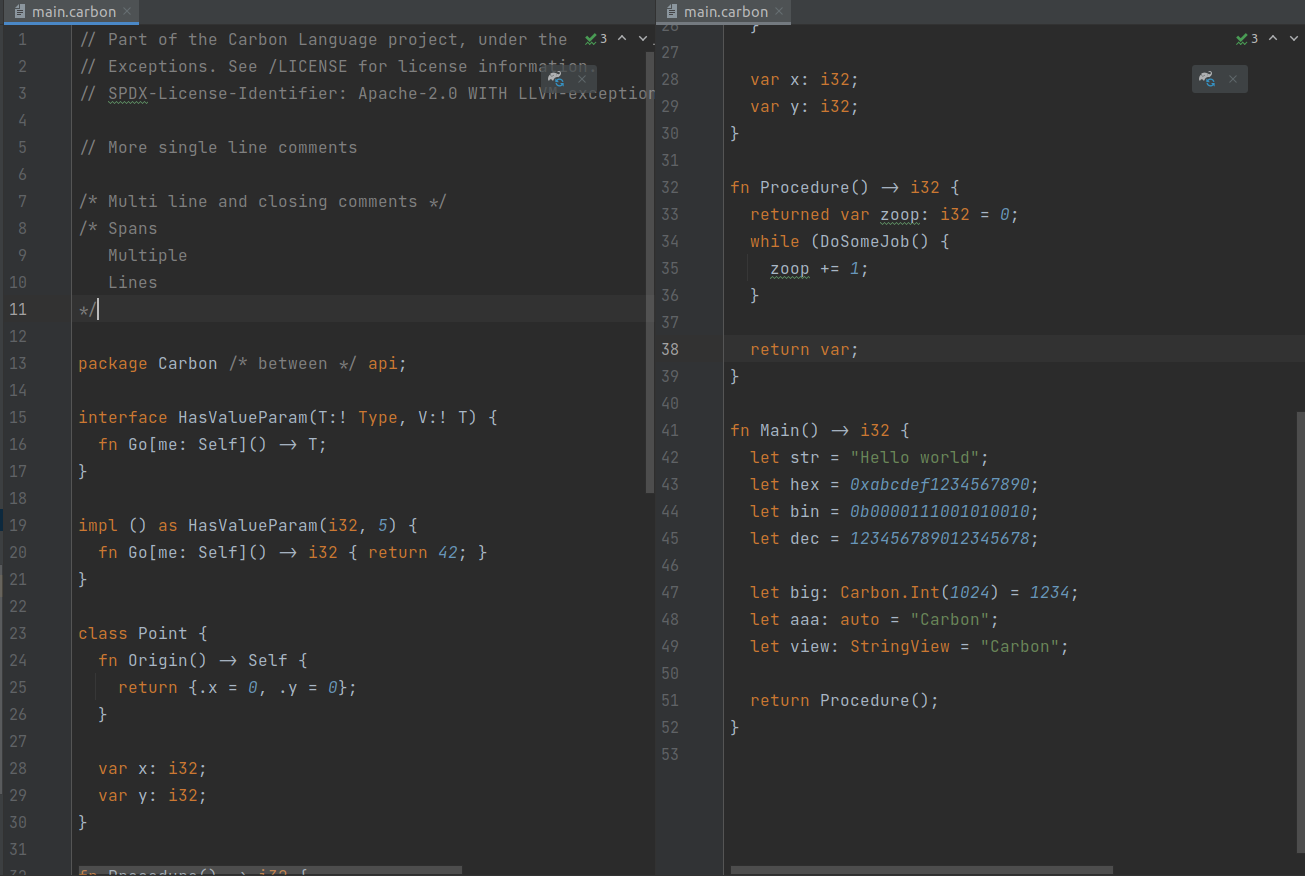
TextMate is the go-to definition language for syntax highlighting for editors lack dedicated language support for a given programming language. This patch contains a very minimal, yet functional TextMate bundle definition for Carbon.
This allows Carbon users to import the TextMate bundle into their editors to get basic syntax highlighting for Carbon code until we have a more solid specification for the language (that's when the fun with dedicated plugins/extensions begins!).
**Support**
- String literals with escape codes (currently using C highlighting rules)
- Numeric literals in decimal, hexadecimal and binary (lacks _ separator support though)
- Single and multi-line comments
- Highlighting of all? (let me know if some are missing) keywords in the language
Here is an image of the highlighting in action in IntelliJ Dracula mode
Following a short discussion on Discord about where to locate developer tools, I suggest we collect developer utils inside a `/utils` directory at the repository root.

The idea behind this directory is taken from LLVM's utils directories in the various LLVM subprojects which host tooling such as Vim and VSCode extensions, utility scripts, and other useful bits for developers developing or using LLVM.

This patch moves the highlightjs code into said utils directory.

Let me know if there's anything else that's missing 😄

cc @jonmeow
 Karthik Prakash
 czapiga
 Jon Ross-Perkins

 Jonathan B. CoeandChandler Carruth
 maan2003

 Richard Smith
 pseyfert
 x2wandJon Ross-Perkins
 Mats Larsen
 ooxi
ooxi

