Implement the toolchain side of proposal #7254, removing the `:!`
binding
syntax for generic and template parameters in favor of the keywords
`generic`,
`template`, and `runtime` plus contextual defaults for phase.

For valid programs this is semantics-preserving: each binding resolves
to the
same phase, and produces the same SemIR, as it did under `:!`/`:`. The
parser
derives a binding's phase from its syntactic context plus any explicit
phase
keyword; new diagnostics and error recovery for misused keywords are
described
below.

Implementation details for each component:

- Lexer: remove the `:!` (`ColonExclaim`) token, move its virtual
parse-node
  budget onto `:`, and add the `generic` and `runtime` keywords.
- Parser: thread a `BindingContext` (`ExplicitParam`, `DeducedParam`, or
`CompileTimeEntityParam`) from declaration introducers down through
parameter
lists to each binding pattern, using a one-token lookahead to
distinguish a
name-qualifier parameter list from a declaration's own final list.
Parameters
of a compile-time entity (`class`, `interface`, `constraint`, `choice`,
`alias`, `export`, `namespace`) and deduced `[]` parameters default to
checked
generic; explicit function parameters and local bindings default to
runtime.
`HandleBindingPattern` resolves the phase from that context plus the
keyword: a
`generic` keyword needs no node of its own (the phase is carried by the
  binding's node kind), while a `runtime` keyword is preserved as a
`RuntimeBindingName` node so `check` can name it in a diagnostic. A
phase
keyword that is merely redundant with the contextual default is
diagnosed
  here, without invalidating the parse tree.
- Check: a phase keyword that is invalid for its context (for example
`runtime`
on a checked-generic parameter) is diagnosed here, and recovers by
building an
error binding that still introduces the name so that later uses of it do
not
  produce cascading errors.

The removed `:!` syntax is now rejected as an ordinary parse error.

The `form`/`:?`/`->?` ("extended types") portion of proposal #7254 is
left for a
separate change.

Assisted-by: Claude Code
Implements proposal #7016: `self` moves from the deduced implicit list
(`fn F[self: Self]()`) to the front of the explicit list. Its type may
be written explicitly (`fn F(self: Self)`) or omitted, in which case it
defaults to `Self` (`fn F(self)`, `fn F(ref self)`); `self` in the
implicit list is rejected.

Throughout checking, `self` is modeled as the first explicit parameter.
Because a method is just a function whose first parameter is `self`, it
can also be called as an ordinary function with the receiver passed
explicitly (`Type.M(obj, ...)`), not only as `obj.M(...)`. A new
`SemIR::CallArgParamPatterns` helper chooses the parameters matched
against the explicit arguments, excluding a leading `self` only when it
is supplied as a method-call receiver; arity checking, conversion, and
generic deduction use it. The resulting SemIR and lowering are
unchanged: `self` is still `call_param0`, and witnesses, thunks, and
vtables are unaffected.

An omitted `self` type is parsed as a `SelfBindingPattern` node with no
type expression; checking synthesizes the `Self` type so it behaves
exactly like `self: Self`. However, the exact spelling used must match
between a forward declaration and a definition, following #3763's rules
around declaration matching.

Generated functions, thunks, and C++ interop import/export build `self`
as the first explicit parameter, and the `self`-type override (e.g.
Derived->Base for a virtual override) applies to the explicit `self`.
Placement is validated by new diagnostics: `SelfInImplicitParamList`,
`SelfNotFirstParam`, and `SelfOutsideParamList`. The benchmark source
generator and the documentation adopt the `(self)` shorthand; the
prelude, the examples, and the test data are migrated in the following
commits.

Assisted-by: Claude Code with Claude Opus 4.7

---------

Co-authored-by: josh11b <15258583+josh11b@users.noreply.github.com>
This PR improves the vscode syntax highlighting.

- Added `comment` keys.
- Added highlighting of invalid numbers such as `0x`, `0b`, `0xa`, etc.
- Restricted highlighting of numeric type literals to common types to
avoid highlighting identifiers such as `i1`.
- Changed the highlighting of named operators (e.g., `as`).
- Added `char` and `str` to type literals.
- Added `const` to modifier keywords.
- Removed `addr` keyword.
- Refactored some rules to use `begin`/`end` to handle line breaks.
- Added highlighting to `choice` values as `enum` values.
- Updated the rules for matching `types`.
- Added highlighting to rhs of `adapt`, `alias`, `choice`, `constraint`,
`impl`, `interface`, `as`, and `impls`.
    - Added highlighting to rhs of bindings.
    - Added highlighting to function return types.
- Updated the rules for matching `functions`.
- Updated the rules for matching `variables`.
- Added highlighting unidentified words as `variable`.
- Added examples and before/after screenshots.

| Before | After |
| :---: | :---: |
| <img width="424" alt="before"
src="https://github.com/user-attachments/assets/e84d0ff9-237b-40c2-845b-ec550b8f7bea">
| <img width="431" alt="now"
src="https://github.com/user-attachments/assets/2c18640b-318a-4cd5-952c-bad61d3fdbca">
|

---------

Co-authored-by: Dana Jansens <danakj@orodu.net>
Also make minor updates to the skeletal design in
docs/design/name_lookup.md following #2113, as there are no longer any prelude names that are made available to unqualified name lookup by default.

Add `type` to the keyword list in
docs/design/lexical_conventions/words.md, following #2360.
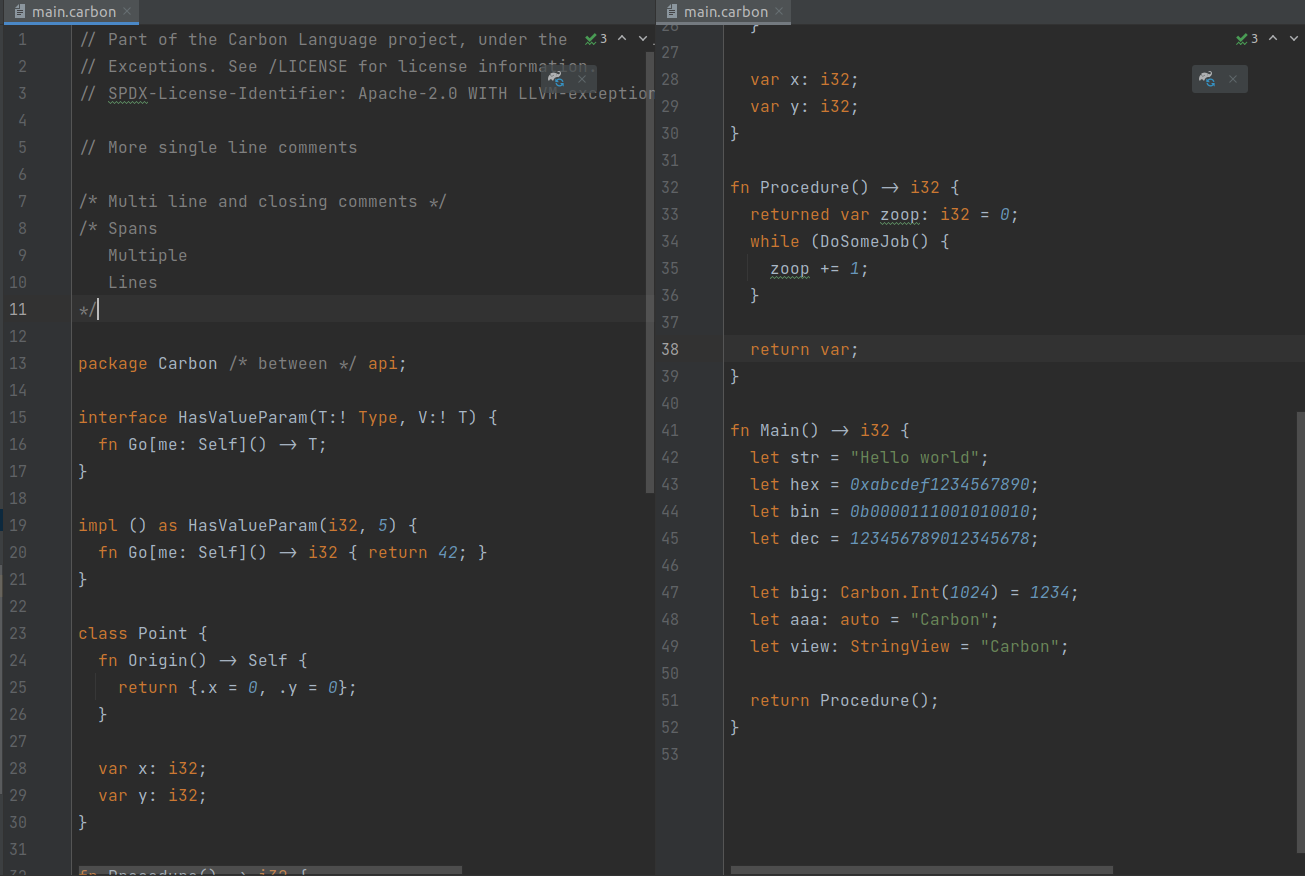
TextMate is the go-to definition language for syntax highlighting for editors lack dedicated language support for a given programming language. This patch contains a very minimal, yet functional TextMate bundle definition for Carbon.
This allows Carbon users to import the TextMate bundle into their editors to get basic syntax highlighting for Carbon code until we have a more solid specification for the language (that's when the fun with dedicated plugins/extensions begins!).
**Support**
- String literals with escape codes (currently using C highlighting rules)
- Numeric literals in decimal, hexadecimal and binary (lacks _ separator support though)
- Single and multi-line comments
- Highlighting of all? (let me know if some are missing) keywords in the language
Here is an image of the highlighting in action in IntelliJ Dracula mode
 Chandler Carruth


 ÖzgürandDana Jansens
 Richard Smith
 josh11b
 Mats Larsen
